We get asked a lot whether Joomla or WordPress is the safer choice. We have built and looked after Joomla sites since 2005, so we are not neutral, and that is exactly why we went looking for public numbers rather than opinions. Here is what the most recent vulnerability data shows for both platforms, and what it does and does not tell you.
The numbers
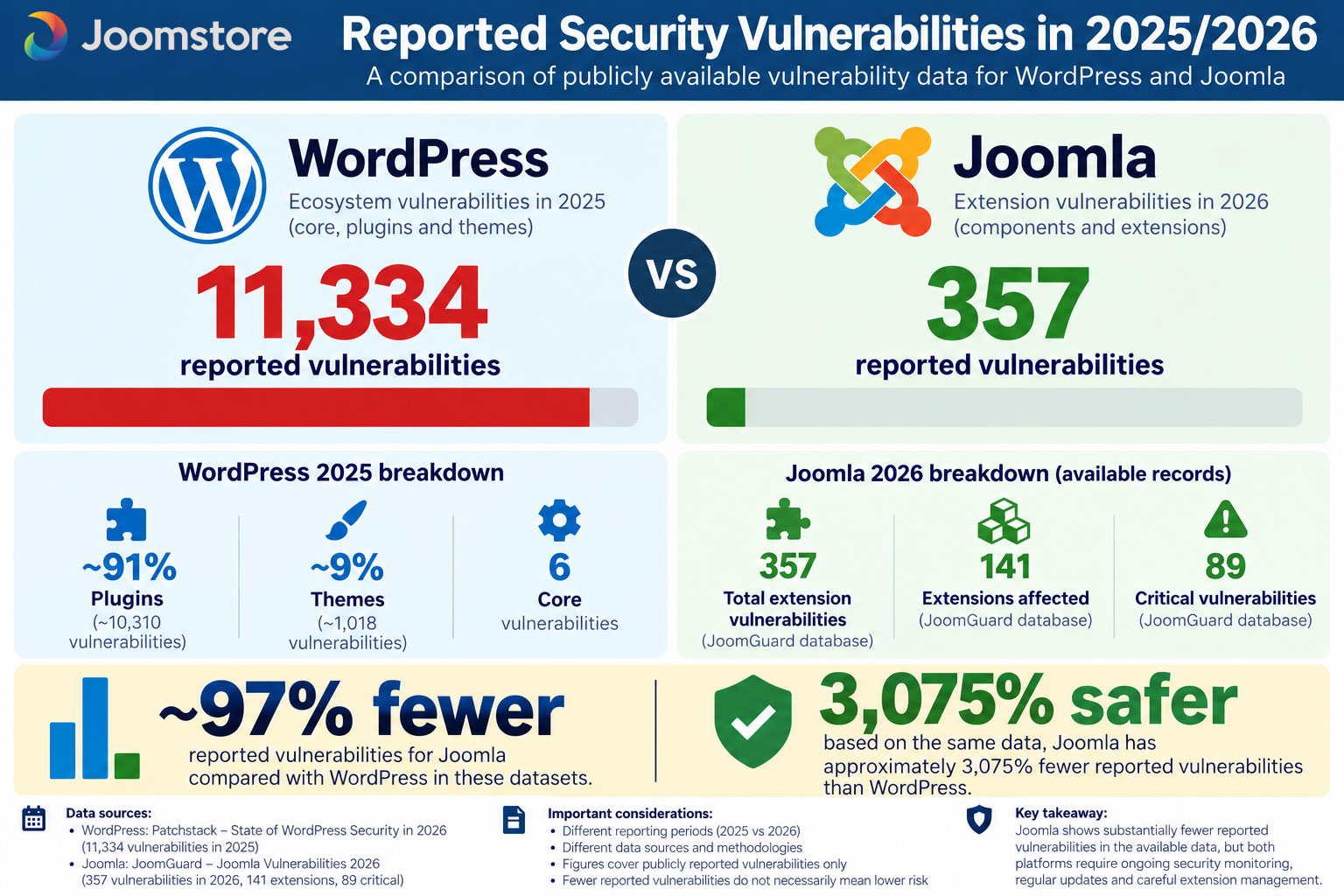
WordPress figures come from Patchstack’s State of WordPress Security in 2026 report, which covers the whole of 2025. Joomla figures come from the JoomGuard database of publicly recorded Joomla extension vulnerabilities for 2026.
| WordPress (2025) | Joomla (2026) | |
|---|---|---|
| Reported vulnerabilities | 11,334 | 357 |
| Where they were found | ~91% plugins (about 10,310) ~9% themes (about 1,018) 6 in WordPress core | Extensions and components, across 141 extensions |
| Most serious | 1,966 rated high severity (17%) | 89 rated critical |
WordPress: full year 2025. Joomla: 2026 records available when we pulled the figures. The JoomGuard database is live and had reached 361 entries for 2026 by 28 October 2026.
In plain terms: Joomla had about 97% fewer reported vulnerabilities than WordPress in these datasets. Put the other way, WordPress had roughly 32 times as many.
What the numbers do not tell you
A raw count is a starting point, not a verdict. Four things are worth keeping in mind before anyone treats it as a security score.
- Different years and sources. The WordPress figure covers 2025 and the Joomla figure covers 2026, from two different organisations with their own methods.
- WordPress is far bigger. WordPress runs about 40% of all websites and Joomla about 1%, according to W3Techs figures for October 2026. More sites and far more plugins means more people looking for flaws, and more flaws found. Per website, the gap is much smaller than 32 to 1.
- Only reported flaws are counted. A vulnerability nobody has disclosed yet does not show up in either number.
- Fewer reports do not mean lower risk. Several Joomla extensions, including the JCE editor, were actively exploited in 2026. One unpatched extension is all it takes. We wrote about that in Surviving the Great JCE Hack of 2026.
Where Joomla does have an edge
The pattern that matters is where the vulnerabilities sit. On WordPress, almost all of them are in plugins and themes; the core itself had just 6 in 2025. Joomla is the same: the problems are in third-party extensions, not the core.
The practical difference is how many add-ons you need. Joomla includes multilingual sites, detailed user permissions, multi-factor authentication and content workflows in the core software. On WordPress, those usually mean extra plugins. Every add-on you do not need to install is one less thing that can go out of date, get abandoned by its developer or become the way in. That smaller footprint is a genuine advantage for serious business sites, and it is a big part of why we still recommend Joomla for complex builds.
What this means for your website
Whichever platform you run, the same few habits decide whether you get hacked:
- Keep the number of plugins or extensions to the ones you actually use, and remove the rest.
- Replace anything its developer has stopped updating.
- Apply security updates within a day or two of release, after a backup.
- Keep the CMS and PHP on supported versions.
- Keep backups off the server, and test that they restore.
- Have someone watching for new vulnerabilities in the extensions you run.
If that sounds like a lot to keep on top of, it is exactly what our website security and maintenance plans are for.
Key takeaway: Joomla shows substantially fewer reported vulnerabilities in the available data, but both platforms need ongoing security monitoring, regular updates and careful extension management.
Common questions
Is Joomla more secure than WordPress?
In the 2025 and 2026 public data, Joomla had about 97% fewer reported vulnerabilities than WordPress (357 against 11,334). WordPress also runs on roughly 36 times as many websites, so part of the gap reflects size. On both platforms, most problems come from third-party plugins and extensions rather than the core software.
How many vulnerabilities did WordPress have in 2025?
Patchstack recorded 11,334 new vulnerabilities in the WordPress ecosystem in 2025: about 91% in plugins, 9% in themes and 6 in WordPress core. 1,966 of them (17%) were rated high severity.
How many vulnerabilities do Joomla extensions have in 2026?
When we pulled the figures, the JoomGuard database listed 357 publicly recorded vulnerabilities for 2026 across 141 Joomla extensions, 89 of them critical. The database is live, so the count keeps rising.
Does fewer reported vulnerabilities mean lower risk?
Not on its own. Risk depends on which extensions you run, how quickly you update, your hosting and backups, and whether anyone is monitoring the site. A Joomla site with abandoned extensions can be far riskier than a well-maintained WordPress site.
Sources
- WordPress: Patchstack, State of WordPress Security in 2026 (11,334 vulnerabilities in 2025; 91% plugins, 9% themes, 6 core; 1,966 high severity)
- Joomla: JoomGuard, Joomla vulnerabilities 2026 (357 vulnerabilities in 2026 across 141 extensions, 89 critical, when the figures were pulled)
- Market share: Colorlib, CMS Market Share 2026, citing W3Techs data for October 2026

Want to go deeper on website security?
Visit Cyberstore, our new sister site dedicated to cyber security. You will find plain-English guides, a free 3-minute security self-check and fixed-price help for hacked websites, PHP, WordPress and Joomla upgrades, and email security.
Visit Cyberstore »Joomla upgrades · WordPress updates · Hacked website repair · Free self-check


